
Every major HRM rollout – Workday, SuccessFactors, Oracle Fusion, Employment Hero or others ultimately lives or dies by one thing: the strength of its people framework. Without a clear job architecture, clean data and defined career pathways, even the best HCM implementations will underperform.
This isn’t just theory. According to Deloitte, only 30% of HR technology implementations deliver their expected ROI. Gartner highlights that over 40% of HR leaders cite poor data quality and inconsistent structures as the single biggest barrier to unlocking value from HCM systems.
The lesson? Technology is rarely the root cause. The missing link is almost always the people framework– the job architecture, reporting line and governance that underpins the system.
A candid field story from my prior employer
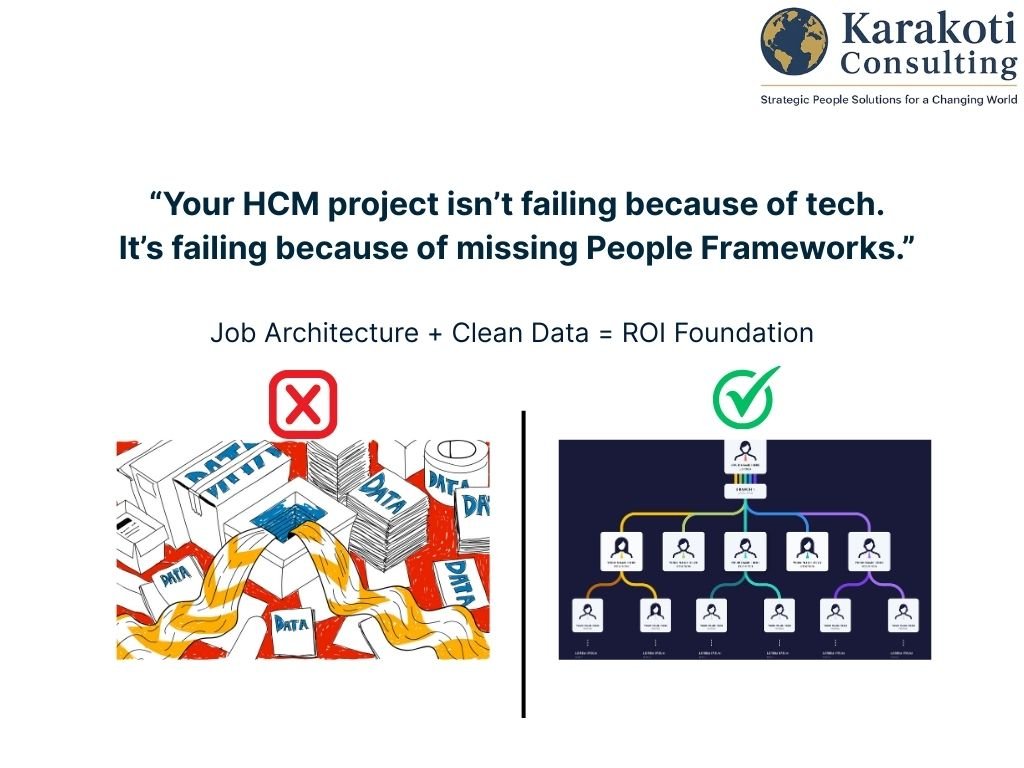
At one of my former employers, Workday was rolled out at speed without first investing in a job architecture or people data clean-up.
The impact was immediate and painful:
- Managers built and trusted their own Excel trackers because Workday reports conflicted with reality.
- Offers and approvals stalled when routing broke down – line managers, Finance and HRBPs weren’t aligned due to misassigned positions and broken reporting lines.
- Workforce planning sat outside the system. When leadership asked for headcount analysis, Workday’s numbers didn’t match the business’s spreadsheets. Reconciling the two wasted weeks of effort at a time when decisions needed to be made in hours.
- Workday capability usage was <30%
The truth was clear: the HCM implementation hadn’t failed but the absence of a structured people framework and job architecture meant it never stood a chance.
Why job architecture is the multiplier for HCM ROI
When a standardised job catalogue, levels and reporting lines exist, HCM platforms become exponentially more valuable:
- Recruitment efficiency: Candidates are mapped to the right role, level and pay band from the start. Misaligned offers (a common cause of delays) reduce dramatically. PwC found organisations with structured job frameworks cut time-to-hire by up to 25%.
- Career pathways: Employees see transparent growth opportunities across functions and geographies. LinkedIn data shows employees stay 2x longer in companies with clear internal mobility frameworks.
- Talent development: Skills mapping and capability frameworks plug directly into the HCM, enabling targeted learning and succession planning. McKinsey estimates this alignment improves internal fill rates by 20–30%.
- Workforce planning: Finance, HR and business leaders trust a single source of truth. Gartner notes that organisations with harmonised job data improve workforce planning accuracy by 35%.
With job architecture, the HCM shifts from being a record-keeping tool to a decision-making engine.
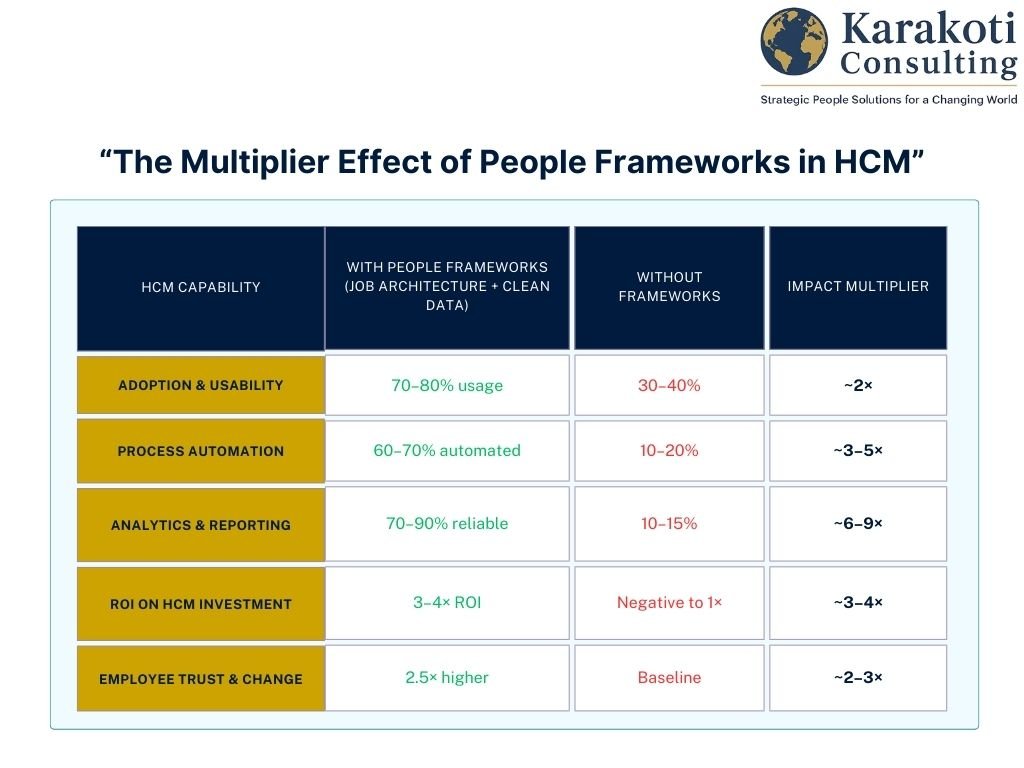
Understanding HCM Implementations Multipliers
Why an SME HR Generalist consultant is critical
One often-overlooked factor in HCM transformation projects is governance. Too often, projects are led solely by IT or vendors with HR in a secondary role. In reality, the difference between failure and success is having an SME HR Generalist consultant (or an in-house expert if they have the capacity as it can be a full-time job) as project co-lead.
Why? Because only an HR transformation consultant with a generalist lens can ensure:
- Job architecture reflects both business needs and compliance requirements.
- HR processes – recruitment, promotions, career pathways are embedded into the system design.
- Data is scrubbed, harmonised and owned by the right stakeholders, not just “mapped” for go-live.
Without this, businesses risk expensive rework, workarounds in Excel and a system that leaders and employees simply don’t trust.
The overlooked ROI
Executives often measure ROI in licence costs vs. process automation. But the real return comes when the people framework is embedded: cleaner recruitment pipelines, transparent career pathways, and faster workforce planning decisions.
For high-growth companies, this isn’t an HR nice-to-have. It’s the difference between scaling confidently or stalling under the weight of manual workarounds and mistrusted data.
Final thought
At Karakoti Consulting Limited, we’ve seen this across multiple clients and industries. The real question isn’t “Which HCM platform should we buy?” but “Do we have the people framework and the right HR transformation consultant co-leading the project to make it work?”
Because without that foundation and without an HR SME Generalist at the table no technology will deliver the ROI it promises.